

Hermes Agent is an open-source autonomous AI agent by Nous Research that builds persistent memory across sessions and self-writes reusable skill documents, meaning it gets demonstrably better the longer you run it. In February 2026, Nous Research quietly released something that looked, on the surface, like another open-source AI agent. Three months later, it had crossed 140,000 GitHub stars, become the most-used agent on OpenRouter, and earned a dedicated hardware integration with NVIDIA. The question isn’t whether it’s popular, the question is why.
What Hermes Agent Is (And What It Isn’t)
Hermes Agent is an open-source agentic AI framework built by Nous Research that runs persistently on your own infrastructure, not a coding copilot, not a chat interface, but a fully autonomous AI agent with cross-session memory and a self-improving skill system. The easiest way to misunderstand it is to drop it into the same category as Claude Code, Cursor, or Aider. Those are genuinely excellent coding tools, but they’re built around one foundational assumption: the agent and the human share a terminal, work through a problem together, and when the session ends, the context evaporates entirely.
Hermes Agent starts from a structurally different premise. It’s built to live on your infrastructure, a $5 VPS, a GPU workstation, a serverless cloud function, and stay running. It remembers what it learned last Tuesday. It recalls the deployment script it wrote three weeks ago. It builds, over time, a working model of your preferences, workflows, and context that compounds across sessions rather than resetting at the start of each conversation.
“The tagline ‘the agent that grows with you’ sounds like marketing copy until you actually run it for a week. Then it starts to feel like a description of something structurally distinct from every other AI tool you’ve used.”
This isn’t a subtle UX improvement. It’s a different thesis about what makes an AI agent valuable. And in the first half of 2026, the developer community has voted on that thesis pretty emphatically, with stars, with token volume, and with the kind of organic community growth that doesn’t come from a marketing budget.
The Self-Improvement Loop
Hermes Agent’s self-improving loop works like this: every time the autonomous AI agent solves a non-trivial problem, it writes a skill document, a reusable, searchable record of how it solved that problem, stored in a local library indexed with FTS5 full-text search. The next time a similar task appears, the agent with persistent memory retrieves the relevant skill and applies it, without starting from scratch and without requiring you to re-explain context covered two weeks ago.
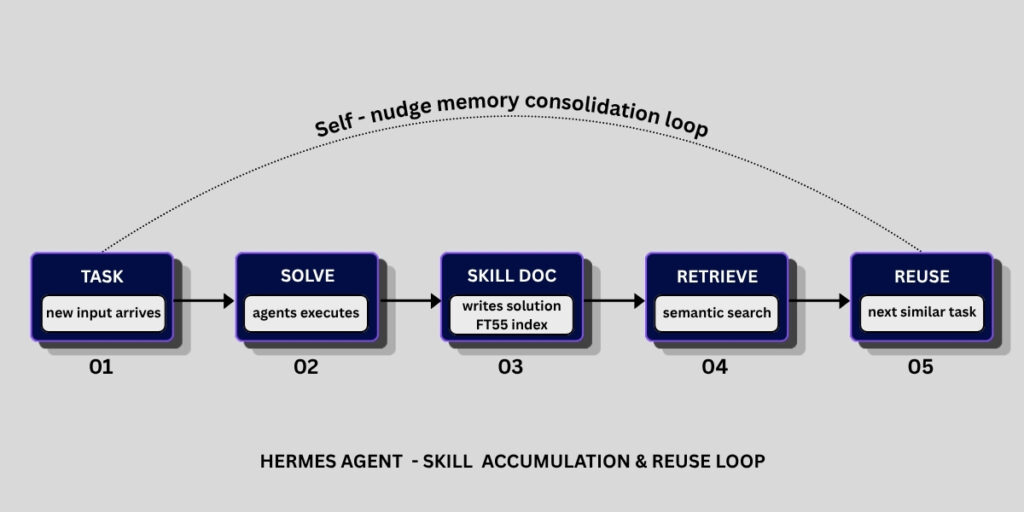
The agent also runs periodic self-nudges: it prompts itself to consolidate what it’s learned and update its memory store, independent of user interaction. Paired with Honcho dialectic user modeling, a system that builds an increasingly accurate profile of your working style and preferences, this creates something that genuinely changes in capability the longer you run it.
Research Validation
Companion research at ICLR 2026 applied DSPy and GEPA to optimize Hermes’s skills and prompts against public benchmarks. Whether that produces compounding gains over time or plateaus after several iterations remains an open empirical question, but the ICLR 2026 companion paper represents the first serious independent validation of the architecture’s core claims.
Architecture: Six Execution Backends, One Agent
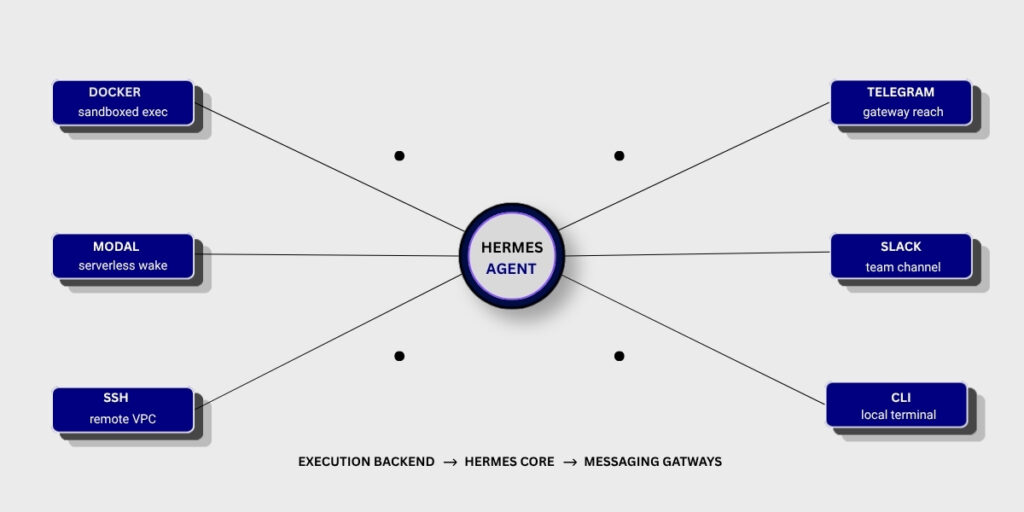
Hermes Agent supports six execution backends, local, Docker, SSH, Modal, Daytona, and Singularity, which means you can run this self-hosted AI agent on anything from a $5 VPS to an HPC cluster while reaching it from any messaging platform. One of Hermes’s most underappreciated design decisions is the clean separation between where the agent runs and where you talk to it. This decoupling is what enables the “patience-requiring” task category that session-bound agents simply cannot handle.
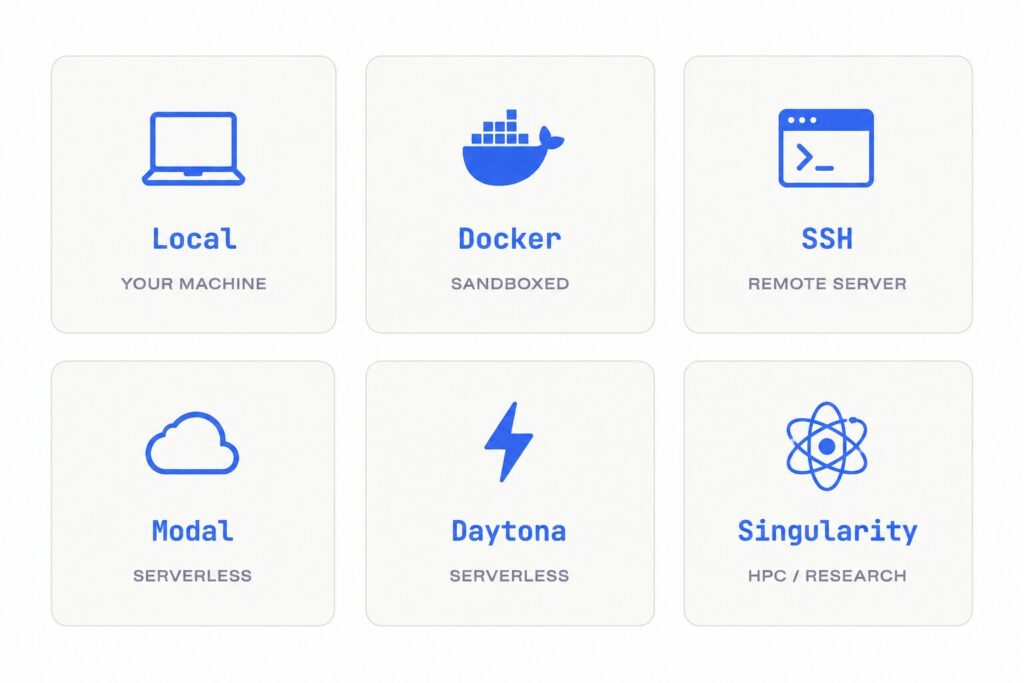
With Modal or Daytona’s serverless execution, your agent’s environment hibernates when idle and wakes on demand — costing nearly nothing between sessions, while staying fully available when needed. You can send a Telegram message from your phone while the agent executes on a cloud VM you’ve never SSH’d into yourself.
That changes the task taxonomy. “Watch this repo and file an issue when the test suite starts flaking” requires patience — the ability to sit and wait. On a laptop-bound agent, that means leaving your machine running or losing context. With Hermes on a persistent remote backend, it’s a one-time scheduled task. “Summarize all Slack threads mentioning our API and send me a digest every Monday at 7am” is the same category of task, tractable with Hermes, impractical with session-bound tools.
The full TUI ships polished: multiline editing, slash-command autocomplete, conversation history, interrupt-and-redirect, streaming tool output. This matters more than it sounds, most agent frameworks treat UX as an afterthought, and the friction compounds badly.
The Gateway: Your Agent, Everywhere
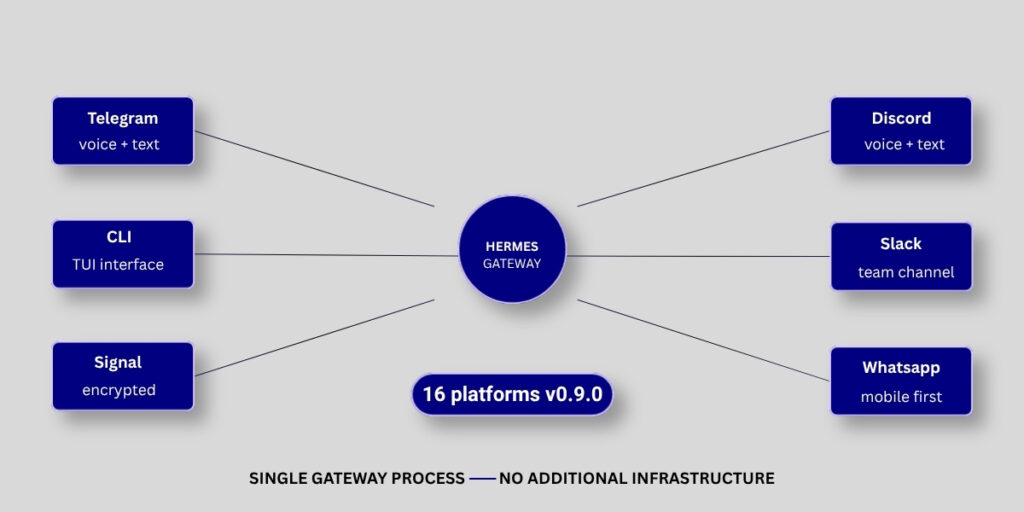
Hermes connects to Telegram, Discord, Slack, WhatsApp, Signal, and CLI through a single gateway process. As of v0.9.0, the platform supports 16 messaging channels. ↗ GitHub v0.9.0 changelog Microsoft Teams has been identified as the most consequential remaining gap for enterprise adoption.
The gateway transforms Hermes from a developer tool into a persistent personal agent. Start it once, walk away, message it from wherever you are. It processes voice memos with transcription and maintains conversation continuity across platforms. A task started in the CLI can be monitored from Telegram. A report triggered in Slack can deliver to Discord. The agent is platform-agnostic; the context travels with it.
Model Agnosticism at Scale
Hermes Agent is fully model-agnostic, working with Nous Portal, OpenRouter (200+ models), OpenAI, NVIDIA NIM, Hugging Face, and any custom endpoint. The Hermes Agent OpenRouter integration is its most-used path, switching models is a single command with no code changes, no configuration migration, and no lock-in.
By May 2026, Hermes was processing over 224 billion daily tokens on OpenRouter, occupying the #1 global daily rank across productivity, coding agents, personal agents, and CLI agents simultaneously, a concentration that’s unusual even for well-funded commercial products.
NVIDIA’s integration announcement positioned Hermes alongside their RTX PCs and DGX Spark workstations, noting that hardware quality directly determines experience quality, a notably candid framing for a GPU manufacturer with obvious skin in the game. The Qwen 3.6 series (27B and 35B parameter models) was specifically cited as optimal for local deployments, outperforming previous 120B and 400B counterparts on agentic tasks.
Hermes vs. Claude Code vs. Cursor vs. OpenClaw: An Honest Comparison
These tools are frequently compared in developer communities, but the comparison is often poorly framed. They target different problems. OpenClaw — the former #1 on OpenRouter before Hermes overtook it in May 2026 — is the most relevant direct competitor. Here’s what the actual differences look like across the dimensions that matter:
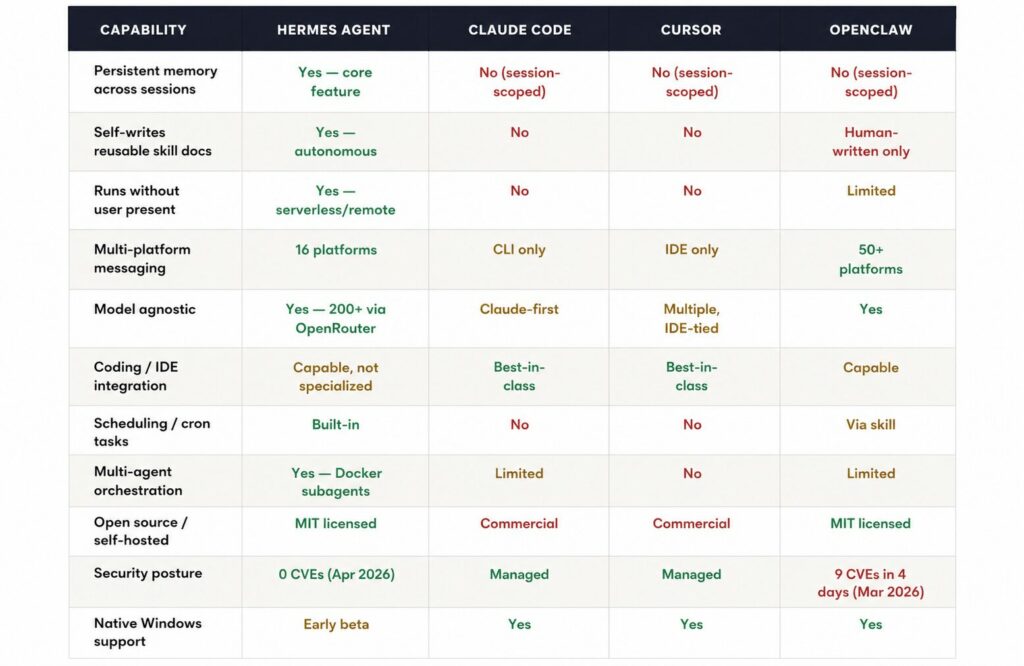
The practical takeaway: if your primary need is deep IDE integration and AI pair-programming, Claude Code or Cursor are better fits. If you need an open-source alternative to Cursor or Claude Code for persistent background automation, Hermes Agent is in a different category. Hermes vs OpenClaw comes down to depth vs breadth — Hermes wins on learning depth and security posture; OpenClaw still leads on raw integration count. For solo developers or small teams running the agent daily over 6+ months, the self-improving autonomous AI agent compounds in ways OpenClaw cannot.
Real-World Use Cases
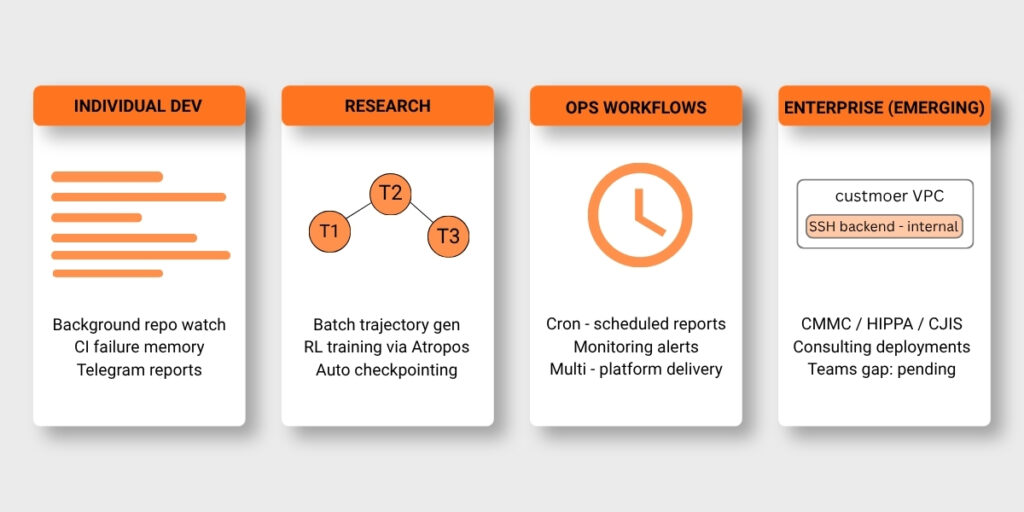
Individual Developers
Persistent background monitoring, automated repository watch tasks, CI failure analysis with memory of past debugging patterns, and scheduled reports delivered to Telegram or Signal without manual intervention.
Research Teams
Hermes ships with a dedicated research mode: batch processing, trajectory export, and RL training integration via Atropos. Thousands of tool-calling trajectories generated in parallel with automatic checkpointing — fine-tuning infrastructure baked into the base install.
Ops-Heavy Workflows
The built-in cron scheduler handles report generation, system monitoring alerts, and regular status updates with delivery to any connected platform. No additional scheduling infrastructure, no webhook plumbing.
Enterprise (Emerging)
The SSH backend enables deployment inside customer VPCs for consulting engagements. Compliance-focused deployments under CMMC, HIPAA, and CJIS are actively being explored. Microsoft Teams integration remains the primary unlock for broader enterprise adoption.
Where Hermes Agent Is Genuinely Limited
No honest analysis of a tool this new skips this section.
Model Quality
The self-improvement loop’s value is directly contingent on model quality. Users deploying smaller local models for cost reasons will find skill documents shallower and memory entries sparser than the benchmark results suggest. Claude and GPT-4-class models produce notably richer output. The gap is real and the documentation undersells it.
Observability
Multi-agent coordination, Hermes can spawn isolated subagents in parallel Docker containers, is powerful but opaque. When three subagents fail simultaneously, debugging requires crawling individual session logs. The Kanban board orients the workflow; the observability tooling doesn’t yet match the capability.
Windows Beta
Native Windows support is in early beta. Linux, macOS, and WSL2 paths are mature and well-documented. Teams with Windows-first environments will encounter real friction that the docs don’t fully surface.
Skill Ecosystem Maturity
The 118 bundled skills are curated and stress-tested. The agentskills.io community hub launched mid-2025 but the ecosystem is still shallow. Network effects require more time and a larger contributor base to materialize.
Unverified Claims
The “self-improving” positioning depends on an empirical claim, compounding benchmark improvement over time, that the research community hasn’t fully verified outside controlled settings. The ICLR 2026 companion paper is promising. Whether gains compound or plateau with real-world, long-horizon deployments requires 6–12 more months of production data.
What Hermes Agent Signals About the AI Agent Space
The 140,000-star trajectory in under three months isn’t noise, it’s a signal about what the developer community has been waiting for. Not another impressive demo. Not a new benchmark result. A framework built on a coherent thesis about what makes an agent valuable over time.
The thesis Nous Research is advancing is specific: agent value compounds through memory, workflow recovery, and accumulated skill, not through the intelligence of any single inference call. That’s a materially different bet than the “smarter model solves everything” assumption that has dominated AI infrastructure investment since 2023. And if that bet proves correct, it shifts the competitive landscape away from model quality as the primary differentiator and toward infrastructure: memory architecture, skill ecosystems, deployment persistence.
“The fact that the most-used agent on OpenRouter in May 2026 is MIT-licensed and self-hosted says something important about where developer trust is currently being placed, and where it isn’t.”
Whether the thesis holds at scale depends on three variables: the maturation of the agentskills.io ecosystem into a genuine network, the quality of Honcho user modeling over long deployments with diverse users, and whether enterprises can navigate the trust gap around systems that write and refine their own skills. The early evidence is strong. The open questions are real. The next twelve months will be more informative than the last three.
Frequently Asked Questions
How do I install Hermes Agent? What are the system requirements?
Hermes Agent installs on any Linux, macOS, or WSL2 environment. The quickest path is the official one-line install script: curl -fsSL https://raw.githubusercontent.com/NousResearch/hermes-agent/main/scripts/install.sh | bash. For Docker sandboxed deployment or Modal serverless setup, follow the official documentation at github.com/NousResearch/hermes. Minimum hardware for always-on remote deployment is 2-core / 4GB RAM, a $5/month VPS is sufficient. Native Windows support is in early beta; WSL2 on Windows is the recommended path currently.
What is Hermes Agent, and who built it?
Hermes Agent is an open-source autonomous AI agent developed by Nous Research, released in February 2026. Unlike coding copilots or chat interfaces, it’s a persistent, self-hosted agent that builds memory across sessions, creates and reuses skill documents, and connects to 16 messaging platforms through a single gateway process. It is MIT-licensed and fully open-source.
How is Hermes Agent different from Claude Code or Cursor?
Claude Code and Cursor are session-scoped: the agent and developer work together in a terminal or IDE, and context resets when the session ends. Hermes Agent is designed to run continuously on remote infrastructure, accumulate memory and skills over time, handle scheduled tasks without user presence, and be reached from any messaging platform. The use cases are complementary, not competing. Cursor/Claude Code for deep IDE work; Hermes for persistent, background, cross-platform agentic workflows.
Is Hermes Agent free to use?
Yes. Hermes Agent is MIT-licensed and fully open-source. You bring your own model API keys (via OpenRouter, OpenAI, Nous Portal, or any compatible endpoint) or run local models. There is no subscription, no usage telemetry to Nous Research, and no data leaves your machine unless you explicitly configure a remote endpoint.
What hardware does Hermes Agent require?
It runs on any Linux, macOS, or WSL2 environment. For always-on remote deployment, 2-core / 4GB RAM is the documented minimum. NVIDIA RTX PCs and DGX Spark workstations are the current reference hardware for optimal local model performance. For serverless deployment via Modal or Daytona, your local machine specs are irrelevant, compute is provided on demand.
Can enterprises deploy Hermes Agent?
The architecture supports enterprise deployment, including SSH backends inside customer VPCs and multi-platform messaging integration. Compliance-focused deployments under CMMC, HIPAA, and CJIS frameworks are actively being explored by early adopters. Microsoft Teams integration is the primary gap for broad enterprise adoption. A managed enterprise wrapper is considered the natural next step by the community.
Does Hermes Agent work with local or open-source models?
Yes, Hermes is fully model-agnostic and supports any OpenAI-compatible endpoint, including locally running models. The Qwen 3.6 series (27B and 35B) has been specifically identified as optimal for local deployment as of May 2026. The self-improvement loop’s output quality varies with model quality, smaller models produce shallower skill documents. The tradeoff between cost, latency, and loop quality is the primary model-selection consideration.
What is a “skill document” in Hermes Agent?
A skill document is the core mechanism of Hermes Agent’s persistent memory system. It is a structured, searchable record that the autonomous AI agent writes automatically after solving a non-trivial problem, capturing the approach, key steps, and context of the solution in a local FTS5-indexed library. When a similar task appears in a future session, the agent retrieves and applies the relevant skill without requiring you to re-explain context you’ve already provided. This AI agent skill document system is what separates Hermes from session-bound tools: capabilities compound across sessions rather than resetting.
KEY TAKEAWAYS
What to carry forward
- 140,000 GitHub stars in under three months; #1 global agent on OpenRouter by May 2026. — MIT licensed, self-hosted.
- The self-improvement loop — task → skill doc → FTS5 index → retrieve → reuse, is the structural differentiator, not just a UX improvement.
- Six execution backends including Modal and Daytona decouple run-location from talk-location, enabling patience-requiring tasks no session-bound agent can handle.
- 16 messaging platforms via a single gateway process as of v0.9.0; Microsoft Teams is the enterprise.
- 224B daily tokens on OpenRouter; model agnostic across 200+ endpoints with one-command switching.
- Real limitations: model-quality dependency, multi-agent observability gaps, Windows beta friction, shallow skill ecosystem, none fatal, all real.
- The underlying thesis, agent value compounds through memory and skill, not model intelligence, is the strategic bet worth watching in 2026.
Caught feelings for cybersecurity? It’s okay, it happens. Follow us on LinkedIn and Instagram to keep the spark alive.