

Table of Contents
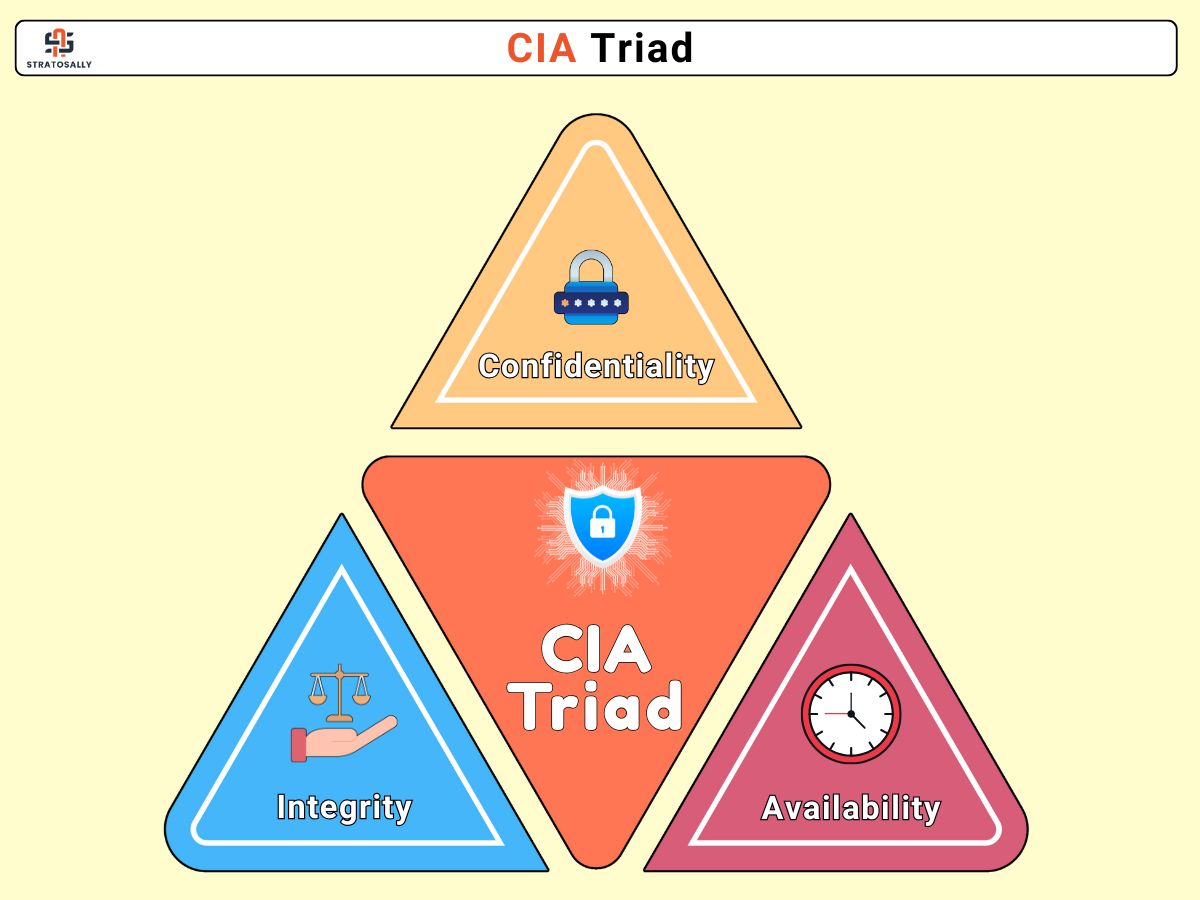
ToggleIn the subject of information security, the CIA Triad provides a key paradigm for developing and assessing secure systems. This model outlines the fundamental goals to which organizations strive to satisfy in an effort to protect their assets and data from harm. The triad’s core pillars, availability, integrity, and confidentiality, serve as key principles that shape security practices, policies, and tools, helping to keep data secure, reliable, and readily available.
The Three Components of the CIA Triad
There are three main parts of CIA Triad, which ensures that the data remains safe and can only be used by an authorised user.
Below we will discuss what these three components are:
Confidentiality keeps sensitive information accessible only to those who are authorized to see it. It relies on tools such as encryption, strict access controls, and secure channels to avoid leaks—whether data is moving across networks or sitting in storage. For instance, shielding personal records from hackers or prying eyes ensures nothing slips out unintentionally.
Integrity protects data from unauthorized changes by ensuring its accuracy and completeness. It commonly uses techniques like digital signatures, hashing, or checksums to detect and prevent tampering—whether during processing, transit, or storage.
Availability makes sure that the systems and data stay accessible and operational whenever they are needed by the authorised user. It counters risks like denialofservice attacks, hardware failures, or natural disasters through redundancy, backups, and robust infrastructure.
These principles are deeply linked—a failure in one can ripple through the rest. True security demands a balanced approach across all three.
The Five Pillars of Information Security
Authentication and nonrepudiation are two different principles added to the traditional CIA Triad that moves around three pillars by some models, resulting in what is majorly called the five pillars of cybersecurity. This module discusses threats in today’s digital world where it is essential to authenticate identity and action.
Authentication is the process of verifying the identity of a person, system, or device before granting access. It strengthens the triad by ensuring that only authorized person interact with protected resources. The three primary types of authentication elements are something you have (like a smart key or hardware token), something you know (like a password or PIN), and something you are (like biometric data like fingerprints or facial recognition). These are paired with multifactor authentication to provide enhanced security.
Nonrepudiation goes beyond authenticit, it stops the sender from saying “I didn’t do it” after sending an email or signing a deal. In the CIA Triad, it’s a key add-on for audits and legal proof—clearing up confusion and making authenticity rock-solid.
Authenticity and NonRepudiation
The CIA Triad is closely linked to authenticity and nonrepudiation, especially when it comes to integrity and authentication.
Authenticity in cybersecurity means making sure a message, document, or piece of data really comes from the person or system it claims to—and that it hasn’t been faked or tampered with. This is usually done using digital certificates, cryptographic techniques, or other reliable verification methods.
Nonrepudiation builds on authenticity by ensuring the sender can’t legitimately deny an action—like sending an email or signing a contract—once it’s done. Within the CIA Triad, it serves as a vital extension, especially for audits and legal accountability, eli minating ambiguity and strengthening authenticity.
Authenticity also connects to integrity and often appears in an “authenticityenhanced” version of the CIA Triad, especially for data verification, even though it isn’t one of the three core pillars.
Distinguishing Overlapping Security Principles
To fully grasp the CIA Triad and its extensions, it helps to separate closely related ideas:
Integrity vs. Nonrepudiation: Integrity prevents and detects unauthorized data alterations to maintain accuracy. Nonrepudiation extends this by identifying the responsible party and preventing denial of actions, enhancing accountability beyond integrity measures.
Nonrepudiation vs. Authenticity: Authenticity verifies the genuine source of data upon receipt. Nonrepudiation provides irrefutable, long-term evidence of the sender’s actions, critical for legal enforceability.
Authenticity vs. Confidentiality: Confidentiality enforces controlled access, ensuring data remains inaccessible to unauthorized parties. Authenticity, by contrast, validates the genuine provenance and integrity of the content, independent of secrecy requirements.
Integrity vs. Authenticity: Authenticity proves the data comes from a genuine source; integrity proves it hasn’t been altered. A fake message could arrive unchanged (integrity holds) yet still fail authenticity.
Authentication starts by verifying a user or system’s identity right before letting them in. More broadly, authenticity ensures that every exchange or piece of data is genuine and not made up.
Nonrepudiation and Authentication: Nonrepudiation locks in actions so they can’t be denied later, but it usually leans on strong authentication to establish who’s really responsible from the start.
In security frameworks centered on authenticity, nonrepudiation sometimes gets folded into the CIA triad—often under integrity or as an addon—to provide stronger defenses against disputes.
Practical Implications and best practice
Putting the CIA Triad into action—along with user verification and proof of actions—means building strong, layered security across your company. Do regular check-ups to spot what needs protecting most. Use tools like firewalls, threat detectors (IDS), and digital certificates (PKI) to keep data private, unchanged, and always accessible. Keep auditing systems and training staff to make everything more reliable and accountable.
Following these steps cuts risks, meets rules like GDPR and HIPAA, and earns trust in your online systems. The CIA Triad is still the backbone of cybersecurity and keeps improving as technology grows in our connected world.
Caught feelings for cybersecurity? It’s okay, it happens. Follow us on LinkedIn and Instagram to keep the spark alive.